Lower back pain usually comes from one of a few sources: the discs, the facet joints, the sacroiliac joint, a compressed nerve root or the surrounding muscles. Each has a pattern. Pain that worsens when standing or leaning backwards and eases when sitting forward points toward the facet joints, while pain that travels below the knee with numbness or tingling points toward a compressed nerve root. Most episodes settle within a few weeks. Pain lasting longer than six weeks, or pain with leg weakness or bladder changes, warrants evaluation. Spine Institute of North America (Spine INA) in East Brunswick, New Jersey identifies which structure is producing the pain before recommending any treatment.
Lower Back Pain Can Be Debilitating
For many people, low back pain isn’t just an inconvenience. The pain can become so severe that it is debilitating and life-changing. More than 80% of adults will have low back pain at some point in their life, and it’s the most common injury or disability that causes people to miss work. That means it’s not only a drain on your quality of life, it can be an economic drain, as well. A study performed in 1990 found low back pain was the sixth-most burdensome condition in the United States when it came to mortality or poor health. By 2010, it was only behind ischemic heart disease and chronic obstructive pulmonary disease.
Low back pain can be dull and constant or a sharp pain that leaves you unable to function. It might start because of trauma to your back, perhaps in a sports-related injury or car accident, but it can also develop from the natural deterioration of your spine as you get older. If you lead a sedentary lifestyle, it can create issues in your lower back, especially if you are sedentary during the week and then strenuously working out on the weekends.
In many cases, the low back pain will resolve itself in a few days or even a few weeks and won’t require a doctor’s intervention. This is known as subacute low back pain. Most back pain won’t result in long-term loss of function, either. If you experience low back pain that lasts for twelve weeks or more, then it is considered to be chronic low back pain and may require the help of a doctor. Most back pain is due to disruption in the mechanics of your spine, meaning that the muscles, discs and nerves aren’t working together and fitting together as they are supposed to do.
Treatments Available for Low Back Pain in Central New Jersey
Almost everyone has experienced low back pain at some time or another. However, if you’re experiencing painful symptoms in your low back on a regular basis, it’s time to visit the knowledgeable team at Spine INA in New Jersey. Only a small percentage of those who struggle with low back pain ever visit a doctor. But these symptoms can be difficult to manage. They can also point to a more serious medical condition.
Don’t try to manage your low back pain on your own. We have convenient locations in East Windsor, Marlton and East Brunswick where our specialists can help pinpoint the cause. We will then provide you with non-operative treatment options to help you manage pain and live a fuller life. If, however, the pain continues even after you’ve utilized conservative measures, our skilled team is equipped to provide least invasive surgical procedures that successfully relieve pain and allow quicker recovery times.
If you’re experiencing low back pain, click on the link below to make an appointment with us today.
Prevention of Low Back Pain
As with all injuries, prevention can go a long way before treatment is required for low back pain. The flexibility in this region of the back is amazing, but it’s also what makes your low back more susceptible to injury from sudden movements or wear and tear. Being proactive and incorporating these steps into your daily life could prevent an injury before it occurs:
Exercise regularly and strengthen your core muscles and those surrounding the low back.
If your job requires lots of sitting, be sure to support the natural curvature of your spine and stand for a few minutes every hour.
Be careful when lifting heavy objects.
Maintain proper weight with nutritional foods and exercise to prevent excess stress on your low back.
Correct your posture, as poor posture can place excessive pressure on your back.
Understanding the Back’s Anatomy
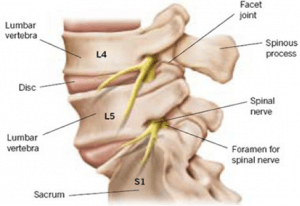
Low back pain often occurs in the five vertebrae (L1 to L5) that make up the lumbar, or lower, region of your back. This area supports the majority of the weight of your upper body. There are spaces between these vertebrae that are filled with round, jelly-like pads that are called intervertebral discs. These are like shock absorbers for your back. They provide cushioning for the bones in your spine, allowing you to move around. There is a junction between your vertebrae that is stabilized by the facet joint. There are also ligaments that hold the vertebrae in place and tendons that attach your back muscles to your spinal column. Finally, there are 31 pairs of nerves that start at the spinal cord and control your movement, sending signals to your brain to help you move and feel.
As you get older, your spine endures a lot of stress and strain. There are changes to the structure of your spine as well, especially in the discs, facet joints and ligaments around your vertebrae. Any changes to these structural elements of the spine can lead to lower back pain.
Most of the causes of lower back pain are due to faults in the mechanics in your back. A majority of the patients we see who are seeking lower back pain treatment have issues associated with something called spondylosis. This is the natural deterioration of your spine over time. The joints, bones, and discs in your back endure a lot of stress and damage over the years and, in many cases, that can start to cause painful lower back issues. Here are some of the common causes we see in our office for lower back pain:
1. Muscle Sprains and Strains: Sprains are caused by ligaments that have been stretched too far. Strains are muscles or tendons that have been torn. These issues are commonly caused by lifting heavy objects incorrectly, twisting the wrong way, or stretching too far. This stretching and tearing can also cause painful spasms in your back. If the issue goes away with time, it’s a strain or sprain. But if the problem doesn’t go away and you experience lower back pain for six months of more, it could be a sign that you are experiencing facet joint syndrome.
2. Degenerative Disc Disease: Yours discs go through a lot over your lifetime, and as you get older the discs in your back can become damaged and dehydrated. This is known as degenerative disc disease. The early stages of the disease are usually painless, but as it progresses you could experience severe pain in the lower back that requires treatment.
3. Herniated or Ruptured Discs: When your discs become compressed over time, they can start to bulge out or even rupture. This can put pressure on the nerves in your back which, in turn, causes severe pain in your lower back.
4. Radiculopathy: This is another lower back pain issue that is caused by compression, injury, or inflammation in the spinal nerve root. Pressure on the nerve can create symptoms such as tingling, numbness or pain in other areas of the body connected by the nerve. Radiculopathy happens when a disc compresses the nerve and creates the symptoms listed above.
5. Sciatica: This is a form of radiculopathy that is caused when the sciatic nerve in your back is compressed. This nerve runs through your buttocks and down the back of your legs. Patients suffering from sciatica may feel shocks of pain or a burning, painful sensation in their lower backs, buttocks, and down one leg, sometimes even extending into the foot.
6. Spondylolisthesis: This condition is caused when the nerves exiting the spinal column are compressed by a disc in the lower back slipping out of place.
7. Traumatic Injury: Not only is lower back pain caused by age and time, it can be caused by traumatic injuries to the back as well. This could be due to sports accidents, car accidents, slip and falls, or other trauma. The results of traumatic injury include damage to the muscles, tendons and ligaments as well as compression on the nerves. It can cause discs to herniate or rupture, too. The results of the damage can cause the patient to need lower back pain treatment.
8. Spinal Stenosis: This condition is caused by the spinal column become more narrow and compressing the spinal cord and nerves. This can cause numbness and pain when you are walking, and if the condition progresses, it can lead to weakness and loss of feeling in your legs.
9. Scoliosis: This condition is usually diagnosed at a young age but might not cause pain in the patient until they reach middle age. Lordosis is a form of scoliosis that’s characterized by an abnormal arch in the lower back. This condition can cause severe pain that requires surgical intervention.
What are the Symptoms of Low Back Pain?
When any one of these conditions become prevalent the following symptoms are associated with these conditions:
Pain in the lower back where there is a tear in your disc. This can cause pain in your buttocks and thighs, too.
Painful back spasms in your lower back and buttocks.
Numbness in the legs or back along with a tightness in the lower back, usually a sign of a herniated or bulging disc.
Weakness in the buttock, thigh, or legs, potentially even losing control of the legs altogether, a sign of compressed nerves in the back.
Tingling sensation in the legs or feet, common in patients with degenerative disc disease or spinal stenosis among other conditions.
If you have been suffering from severe lower back pain for 6 to 12 weeks and attempting to find lower back pain relief from conservative treatments, it may be time to seek a specific diagnosis for the underlying cause of your pain in ordering to find an effective treatment option. When you come to the Spine INA, our doctors will employ any or all of the following tools to help you find an accurate cause for your back pain:
X-ray. This gives the spine specialist information about the bones in your back, and can help them see fractures, tumors, or even pinpoint areas of instability in the spine.
CT scan. These scans are used by our medical team to look for back issues like spinal stenosis or even herniated discs. It shows a cross-section of your spinal discs.
Myelogram. This procedure uses a contrast dye which is injected into your spine, which gives the doctor a better view of your spine during an imaging procedure. It can help them identify issues with your spinal cord and the nerves in your spine.
MRI scan. An MRI is useful to show various elements in your spine and can help your spine specialist identify issues with your lumbar discs or even your nerves. It can help your doctor rule out conditions like infection or tumors that could be the cause of your back pain, too.
Using these imaging methods, tests, and a physical examination, your spine specialist can begin to formulate a diagnosis as to the cause of your back pain and begin to create a plan to provide you with lower back pain relief. Sometimes, though, there may be no known cause of your back pain; but that pain can still be very real. Even in these cases, your doctor will work with you to find the right lower back pain relief for you.
Low Back Pain Relief and Treatment Methods
We offer a variety of treatment options for lower back pain. These can be conservative therapies such as medication and compresses all the way to surgical intervention. Whatever method we choose, our goal is to help you find lower back pain relief and help you maintain the normal function of your back. We recommend trying non-invasive treatment options first before moving onto more invasive methods.
Non-Operative Treatment
Pain medications. This can include anti-inflammatory medications or even narcotic painkillers.
Alternating heat and cold compress on the affected area.
Physical exercise including stretching, massaging and strengthening the affected area.
Epidural steroid injections to relieve inflammation and diagnose the affected area.
Facet Joint or Medial Branch Nerves injections. This can provide you with short-term lower back pain relief and help your doctor diagnose the specific location that’s causing your pain.
Discography to determine which discs in your back are causing the pain you are experiencing.
Platelet-rich plasma injections to help your body heal tissues such as tendons, ligaments, muscles and joints in the back.
Least Invasive Procedures
If none of the treatment options listed above are providing relief, then it may be time to consider one of these least invasive procedure options.
Endoscopic Discectomy – A small incision is made through which the surgeon inserts a camera to look at the annulus and nerves. If there is a tear, it is cleaned and closed.
Endoscopic Rhizotomy– This can provide lower back pain relief to those who experienced temporary relief from a percutaneous medial branch rhizotomy.
Lumbar Radiofrequency Ablation– Thermal energy is delivered to damaged facet joints through a needle to ablate the nerve and disrupt the pain signal that’s being sent to the brain.
Kyphoplasty and Vertebroplasty – These procedures use a bone cement to help strengthen and support discs damaged by spinal compression fractures.
Spinal Cord Stimulator– This method utilizes an electrical pulse that is sent through the spinal cord to the nerve that’s causing the patient’s pain. The signals disrupt the pain signals going to the brain.
Regenerative Medicine – Regenerative medicine seeks to manipulate the body’s own natural processes to stimulate healing.
Recovery
After most least invasive surgical procedures, you should be able to get out of bed about an hour after the procedure and then go home a little while later. You might have some minimal pain and your doctor will provide you with at-home care instructions. You’ll want to rest at home and gradually increase your activity. Be sure to consult your spine specialist before you return to work or resume your normal activities. Any pain should go away in a few days.
 Low back pain often occurs in the five vertebrae (L1 to L5) that make up the lumbar, or lower, region of your back. This area supports the majority of the weight of your upper body. There are spaces between these vertebrae that are filled with round, jelly-like pads that are called intervertebral discs. These are like shock absorbers for your back. They provide cushioning for the bones in your spine, allowing you to move around. There is a junction between your vertebrae that is stabilized by the facet joint. There are also ligaments that hold the vertebrae in place and tendons that attach your back muscles to your spinal column. Finally, there are 31 pairs of nerves that start at the spinal cord and control your movement, sending signals to your brain to help you move and feel.